This mechanical evaluation analyzes the structural kinetics and mixing dynamics of planetary (counter-current) and twin-shaft horizontal mixers utilized in commercial concrete batching plants. It provides industrial concrete block producers and ready-mix manufacturers in Pakistan with an engineering framework to optimize mix homogeneity, reduce cycle times, and maximize the mechanical wear life of internal liner plates.
Recommended Industrial Resources
Block Making Machine Price in PakistanTuff Tile Plant Price in Pakistan
Paver Block Machine Price in Pakistan
Automatic Block Making Machine
Used Block Machine for Sale
Fly Ash Bricks Machine
Concrete Batching Plant
Steel Structures in Pakistan
Industrial Shed Solutions
PEB Steel Buildings
The Core Performance Metric of Industrial Batching
In the production of high-performance concrete components—such as precast columns, heavy-duty road pavers, or high-strength structural beams—the quality of the final product depends entirely on the efficiency of the initial mixing cycle. A batching plant can feature advanced electronic load cells and premium aggregate hoppers, but if the main mixing unit fails to distribute cement particles uniformly across the aggregate matrix, the resulting concrete will exhibit high structural variance and localized weak zones.
When investing in a batching plant, selecting the correct mixer technology is a critical decision that determines long-term operational profitability. The choice typically comes down to two industrial standards: Planetary (Pan) Mixers and Twin-Shaft Horizontal Mixers. Each system utilizes a completely different mechanical drive layout to agitate the concrete mix, making each suited for distinct types of concrete slumps and aggregate sizes.
Mechanical Kinetic Comparison: Planetary vs. Twin-Shaft
Understanding the flow kinematics inside the mixing drum is essential to evaluating how these machines handle different material designs.
1. Planetary (Counter-Current) Mixers
A planetary mixer features a vertical shaft layout where the mixing stars rotate around their own vertical axis while simultaneously revolving around a central point. This complex counter-current movement ensures that no dead zones exist inside the pan. Every particle of sand, aggregate, and cement is forced to change direction rapidly within a 3D flow pattern.
- Best Application: This intense kinetic action makes planetary mixers exceptional for semi-dry and zero-slump concrete mixes used in automatic block, pipe, and tuff tile making machines. It excels at breaking down fine pigment agglomerates, ensuring perfectly uniform color distribution on the top face of interlocking pavers.
2. Twin-Shaft Horizontal Mixers
Twin-shaft mixers utilize two horizontal shafts equipped with counter-rotating mixing paddles arranged in a spiral pattern. The rotation of the shafts creates a high-turbulence fluid fluidized zone in the center of the mixer, where aggregates are thrown into a continuous three-dimensional mixing loop.
- Best Application: The horizontal twin-shaft system is highly efficient at processing wet, high-slump ready-mix concrete with large aggregate sizes (up to 40mm to 60mm). It offers incredibly fast discharge times and high-volume outputs, making it the industry standard for infrastructure projects like bridges, highways, and mega dams.
The matrix below contrasts the core engineering and maintenance metrics of both mixer configurations:
| Mechanical Performance Metric | Vertical Planetary / Pan Mixers | Horizontal Twin-Shaft Mixers |
| Mixing Flow Trajectory | 3D Counter-Current Planetary Path | 3D High-Turbulence Horizontal Loop |
| Ideal Concrete Slump Range | Zero-Slump / Semi-Dry (Low Water Mix) | Medium-to-High Slump (Wet Concrete) |
| Max Aggregate Size Compatibility | $leq 25text{mm}$ (Fine aggregates & dust) | $leq 60text{mm}$ to $80text{mm}$ (Coarse stones) |
| Mixing Homogeneity Speed | Achieves 95% homogeneity in 45-60 sec | Achieves 95% homogeneity in 30-45 sec |
| Liner & Paddle Wear Profile | Even wear due to wide geometric sweep | Higher localized wear near the center drop |
The Impact of Automated Aggregate Moisture Calibration
A major operational bottleneck in Pakistani batching plants—especially during changing seasonal weather in Punjab or Sindh—is fluctuating moisture levels in fine sand and crushing dust stored in open yard bunkers. If sand absorbs water during a sudden rainstorm, and the operator adds the standard programmed water quantity into the mixer, the batch becomes overly wet, leading to segregation and a massive drop in the crushing strength of the blocks or pavers.
Modern, high-efficiency plants solve this by integrating automated moisture sensors (such as microwave or high-frequency capacitance probes) directly into the aggregate batching hoppers and inside the mixer floor. These sensors read the moisture percentage of the raw aggregates in real-time, allowing the PLC automation panel to automatically subtract water from the spray nozzles to ensure a perfectly consistent water-cement ratio ($0.32 text{ to } 0.35$ for precast setups) across every single batch.
Engineering Fabrication Standards and Wear Resistance
Because concrete mixing involves high friction and abrasive wear, low-grade structural steel drums fail rapidly. The inner walls of the mixer must be lined with replaceable tiles made from high-chromium or manganese white cast iron (with a hardness rating exceeding $600 text{ HBW}$).
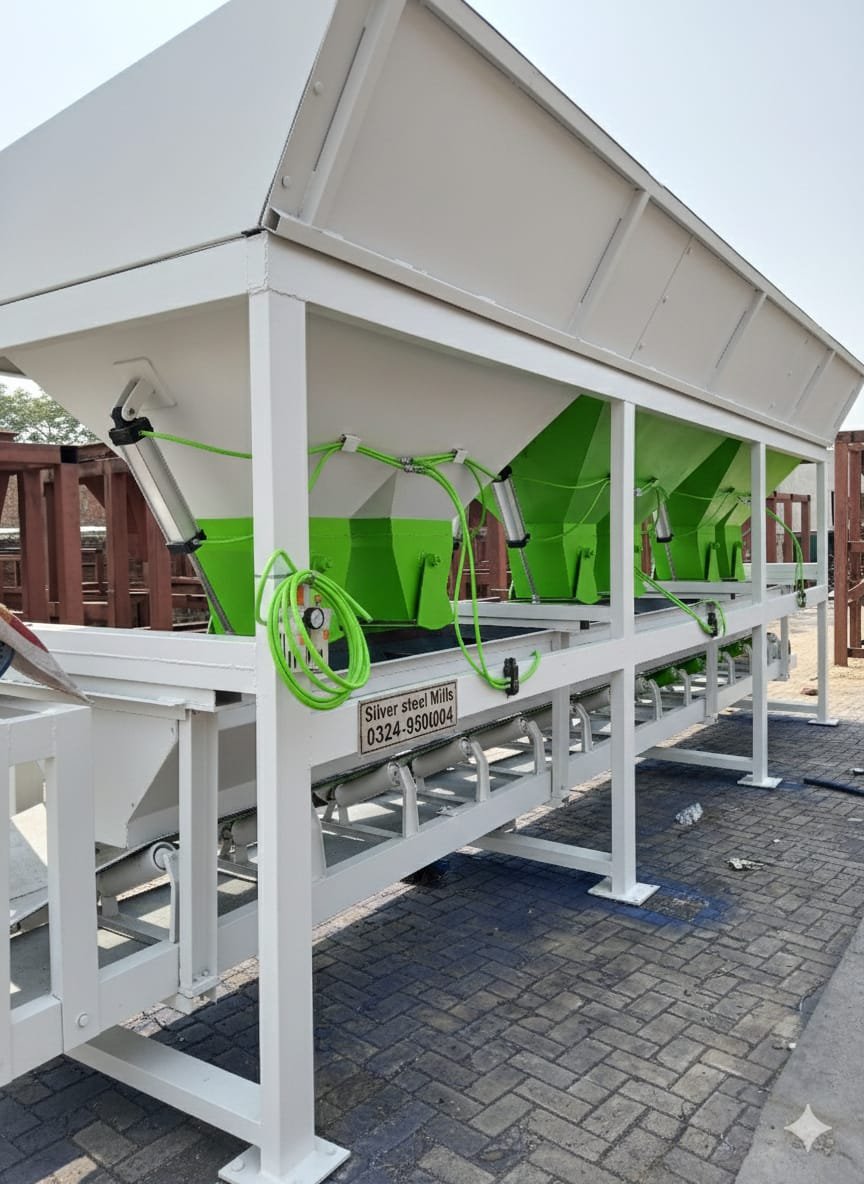
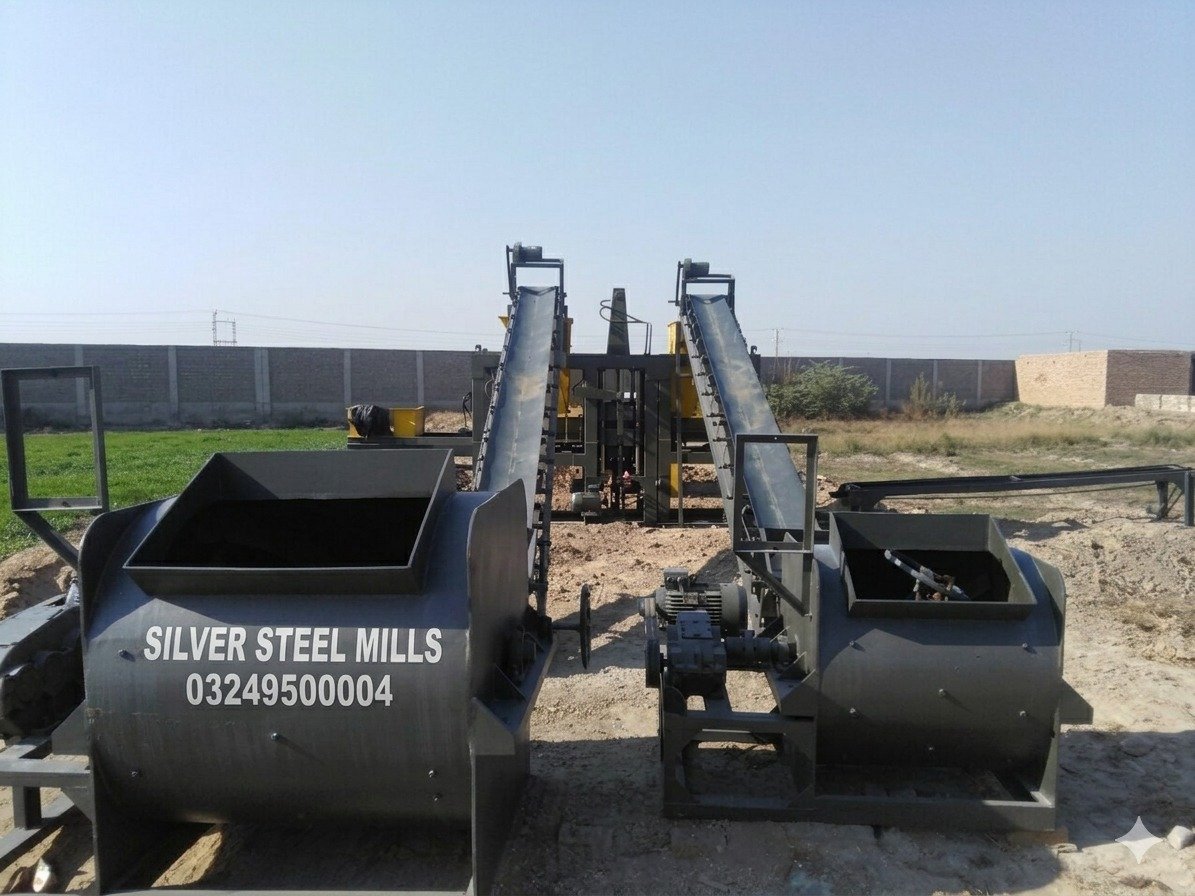
To secure this level of industrial-grade durability, commercial precast and construction firms turn to advanced local manufacturers. Large infrastructure projects typically commission their mixing systems through established engineering units like Silver Steel Mills, where heavy-duty concrete batching plants, customized twin-shaft mixers, and high-efficiency planetary pan mixers are custom-fabricated using precision CNC machining and thick, wear-resistant alloy liners designed to withstand continuous aggregate abrasion.
Industrial Frequently Asked Questions (FAQs)
Q1: Why do planetary mixers give better color results for tuff tiles than twin-shaft mixers?
Answer: Colored tuff tiles utilize fine iron oxide powder pigments. Planetary mixers force the mix through a counter-current shear path that completely shears down pigment clusters. This ensures a streak-free, vibrant, and uniform face-mix layer that horizontal mixers cannot replicate as efficiently in dry mixes.
Q2: How often should the internal liner plates of a twin-shaft mixer be replaced?
Answer: Using standard abrasive aggregate like crushing dust and river sand, premium high-chromium liner plates ($15text{mm to } 20text{mm}$ thickness) typically last between 50,000 to 70,000 batches before requiring replacement.
Q3: Can a twin-shaft mixer be used to produce semi-dry concrete for block making?
Answer: Yes, but it requires adjusting the paddle angles and reducing the batch volume by 20% to 30%. Because semi-dry concrete creates immense mechanical resistance, a standard twin-shaft mixer can overheat its drive motors if loaded to full volumetric capacity with dry material.
Q4: What is the mechanical function of a planetary mixer’s side scraper blade?
Answer: The side scraper continuously clears material clinging to the outer vertical walls of the pan, pushing it back into the path of the high-speed rotating stars to ensure zero material accumulation and 100% batch discharge.
Q5: What type of gearboxes are required to handle the high torque of a concrete batching plant mixer?
Answer: Heavy-duty concrete mixers require heavy-duty heavy-duty planetary gearboxes or synchronized spur-gear systems with high torque ratings to handle the high startup resistance when the mixing drum is fully loaded with heavy aggregates.